
How role-based compliance training boosts learner engagement and meets regulator expectations
- Updated
- 9 min
For L&D Teams
Why awareness training alone isn’t enough
Ticking the box when it comes to compliance training has never been enough. Yet for years, compliance training in many organisations has done exactly that, delivering the same generic content to every employee, regardless of their role, their risk exposure, or how likely they are to encounter a compliance issue in their day-to-day work.
The result? Learners click through slides without reading them. Assessment scores are inflated. And when a real compliance situation arises, people fall back on instinct rather than compliance training, because it never felt relevant to them in the first place.
For Learning and Development professionals, this is both a problem and an opportunity. Regulators are raising the bar on what “adequate” compliance training looks like. And the tools and methodologies now exist to build compliance training that genuinely changes behaviour, not just awareness scores.
Key insight: High completion rates are not evidence of an effective compliance training program. If learners are not engaging with content that reflects their actual role, awareness is superficial at best.
The problem with generic compliance training
Generic compliance training fails at the moment of relevance. When scenarios don’t reflect a learner’s actual role, the brain does something predictable: it disengages. This isn’t a motivation problem. It’s a design problem.
Research in adult learning consistently shows that people retain and apply information far more effectively when it connects to their real context. When generic compliance training is used, organisations commonly see:
- Learners clicking through modules without genuinely engaging
- High completion rates masking low comprehension
- Employees unable to apply what they covered when a real situation arises
- A false sense of security that leaves the organisation exposed
Consider a learner who completes a generic anti-bribery and corruption module. They may finish with a passing score but still have no clear sense of what to do if a client offers them a gift, a hospitality invitation, or an informal commission arrangement. The compliance training covered the topic. It just didn’t prepare them for the moment.
Key insight: Generic compliance training does not just fail learners. It can create a dangerous illusion of preparedness, leaving organisations exposed when it matters most.
What regulators actually expect
Regulatory bodies, including ASIC, APRA, and equivalent bodies across the Australian landscape, have become increasingly explicit about their expectations for compliance training. The shift is clear: generic, one-size-fits-all compliance training is no longer considered sufficient.
Regulatory expectation | What this means in practice |
|
|
|
|
|
|
|
|
The message from regulators is consistent: compliance training must be purposeful, proportionate, and role-based. It must be designed with the learner’s actual work in mind.
Key insight: Regulators are not just looking at whether compliance training was delivered. They are asking whether it was the right compliance training, for the right people, at the right level of depth.
Scenario-based learning: what it is and why it works
Scenario-based compliance training places the learner inside a situation, a conversation, a decision point, a moment of ambiguity, and asks them to respond. Rather than presenting rules in the abstract, it shows what those rules look like in practice.
Done well, scenario-based compliance training:
- Creates cognitive engagement. When a learner has to make a choice and then see the consequence of that choice, they engage with the compliance training material at a deeper level. The brain processes it as experience, not information.
- Reveals how people actually think. A well-constructed scenario exposes the reasoning traps and justifications that cause compliance failures: the “everyone does it” rationalisation, the “it’s just a small favour” dismissal, the deference to a manager that overrides policy. Compliance training that surfaces these patterns gives learners the language and tools to recognise and resist them.
- Builds confidence. Learners who have worked through realistic scenarios in their compliance training feel more prepared when they encounter similar situations in real life. They have rehearsed the decision before the stakes are real.
- Supports better assessment. Scenario-based compliance training assessments are significantly harder to game than multiple-choice knowledge checks. They require application, not just recall, which gives L&D teams and regulators a more meaningful picture of learner capability.
Key insight: Scenario-based compliance training doesn’t just improve engagement scores. It changes the quality of decisions people make when a real compliance situation is in front of them.
Designing for role relevance
The most effective compliance training starts not with the regulatory requirement, but with the learner’s world. Before a single piece of content is written, L&D teams should be asking:
- What decisions does this role make that carry compliance risk?
- What pressures or incentives might lead someone in this role to make a poor compliance decision?
- What does a grey area look like for this role, and how should it be navigated?
- What language does this role use, and what scenarios will feel authentic to them?
The answers to these questions should drive the design of compliance training content, scenarios, and assessments. A compliance training scenario written for a mortgage broker should feel nothing like one written for a claims assessor, even if both modules are nominally about the same regulatory obligation.
Role-based compliance training also allows organisations to calibrate the depth and frequency of training to the level of risk associated with each function. High-risk roles require more frequent, more detailed, and more challenging compliance training. Lower-risk roles may need a different cadence but still benefit from content that speaks directly to their work.
Practical steps for L&D teams
If you’re reviewing your compliance training program, here are some practical starting points:
- Audit for role relevance. Review your current compliance training content by role. Ask honestly: does this scenario reflect the real decisions this person makes? If the answer is no, the compliance training needs to be redesigned, not just refreshed.
- Move from knowledge checks to application assessments. Replace true/false and simple recall questions with scenario-based compliance training tasks that require learners to work through a situation and explain their reasoning.
- Map compliance training to regulatory expectations explicitly. Document how each compliance training element addresses specific regulatory requirements. This makes it easier to demonstrate adequacy to a regulator and to identify gaps when obligations change.
- Segment your learner population. Not all employees carry the same compliance risk. Build a clear picture of which roles require which compliance training, at what frequency, and to what depth, then design accordingly.
- Measure what matters. Move beyond completion rates. Track compliance training assessment outcomes, retest rates, and where possible, link training data to compliance incident data to understand what is and isn’tworking.
Key insight: Reviewing your compliance training program is not a once-a-year task. Role changes, regulatory updates, and incident trends should all trigger a reassessment of whether your compliance training content is still fit for purpose.
How Elevated Learning was built to solve this
At Safetrac, we have spent more than 25 years as a trusted compliance solutions partner for regulated industries across Australia. In that time, we have seen the same challenges surface repeatedly across organisations of every size, from ASX-listed enterprises to fast-growing workforces.
- Compliance courses keep stacking up, and so does the burden on L&D teams to manage them
- Managers end up doing double the compliance training because role-based filtering doesn’t exist
- Keeping content legally current feels never-ending, with manual updates and re-uploads eating up resources
- Learners sit through compliance training they don’t need, covering content they already know, in scenarios that don’t reflect their work
That experience is what led our team of legal experts and learning specialists to develop Elevated Learning, a smarter, faster, adaptive compliance training solution designed specifically to reduce compliance burden while meaningfully improving learner engagement.
What makes Elevated Learning different:
- Adaptive learning pathways tailored to each employee’s role, industry, and jurisdiction, so every learner gets compliance training that is relevant to them
- Pre-assessments that allow confident learners to skip what they already know, respecting their time and focusing effort where it is genuinely needed
- Realistic, industry-specific scenarios that reflect the actual decisions learners face at work, boosting both engagement and genuine understanding
- Automatically updated legal content so your compliance training stays current without re-uploads, manual fixes, or L&D team intervention
- Up to 60% course completion time savings for managers and employees, without sacrificing accuracy or rigour
- SCORM-ready via Thin Package files with auto-updates, or hosted on the Safetrac platform to fit your existing learning infrastructure
For L&D teams navigating the dual pressure of learner engagement and regulatory scrutiny, Elevated Learning provides a framework that serves both. Compliance training that learners actually engage with is also compliance training that produces the evidence of genuine understanding that regulators expect to see.
Ready to get your compliance training program reviewed?
Generic, tick-box compliance training is no longer good enough, for your learners or your regulators. The most effective L&D teams are moving toward role-based, scenario-driven compliance training that builds real capability, and Safetrac’s team of legal experts and learning specialists can help you get there.
Two ways to get started:
Request a demo of Elevated Learning in action and see adaptive pathways, pre-assessments, and real-world scenarios working together.
Book a compliance training program review with our team to assess your current compliance training against regulatory expectations and map the ideal journey forward.
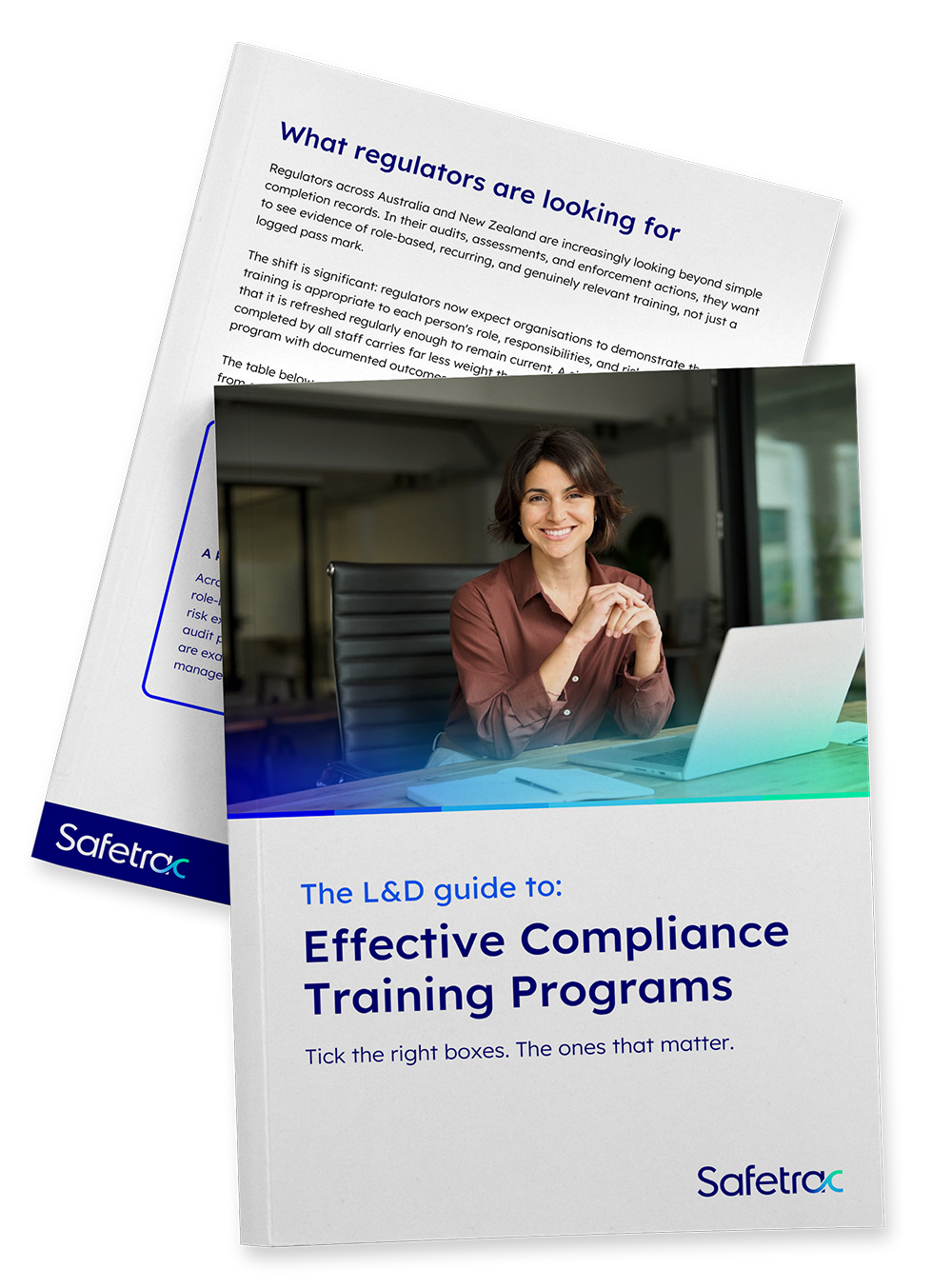
Get your 2026 guide to effective compliance training programs
Download your copy to find out the key areas to look for when designing an effective compliance training program.
Get the latest news
Stay updated with the latest news and expert insights on compliance, legislation, and industry trends.