From AI and cyber threats to regulatory change and geopolitical uncertainty, risk and compliance teams are being asked to make faster decisions across a growing range of issues.
These pressures shaped the conversation at Forefront Events’ Governance, Risk and Compliance Summit NSW 2026, where Safetrac CEO Deborah Coram opened the day with a short audience spotlight before facilitating a panel discussion with senior risk and compliance leaders.
A quick read of the room
During the spotlight session, attendees were asked three questions about their current compliance challenges and priorities. Across 77 responses, a number of areas consistently popped up.
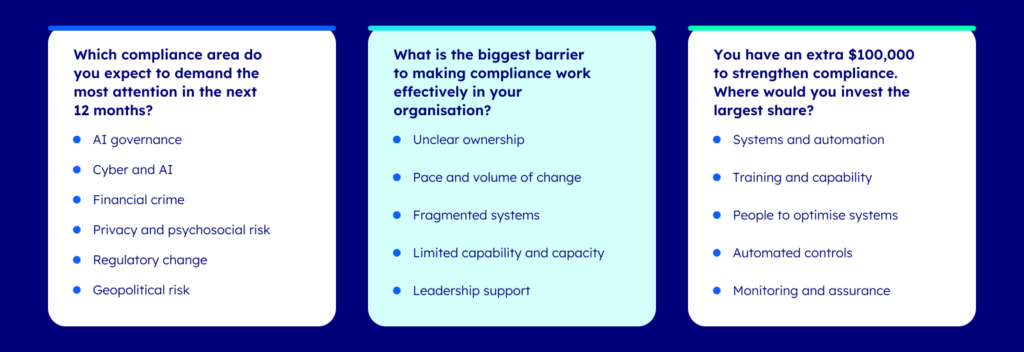
The responses highlighted a strong focus on AI governance and cyber risk, alongside the need for clearer ownership, stronger capability and systems that can keep pace with change.
The panel continued the conversation through five key discussion topics.
-
AI and automation require strong governance
As controls become increasingly automated, governance and direction from leadership remain essential. AI can help teams identify which cases need human investigation, increased resources and strengthened monitoring. It is also changing how organisations verify requests, protect information and respond when incidents unfold publicly.
Deborah Coram explores how practical compliance training can help organisations manage AI risk and support responsible use in AI. Read more in her article.
-
Prioritisation is becoming harder
GRC teams are balancing AI, cyber, privacy, sanctions, modern slavery, Respect@Work, psychosocial risk and continuous regulatory change. The panel explored how leaders determine what requires immediate attention, what can reasonably wait and how they maintain confidence that significant risks are being addressed.
Safetrac can reduce the administrative load through outsourced training rollouts, while Elevated Learning keeps training aligned with legislative change automatically, giving GRC teams more time to focus on emerging risks and priorities.
-
Geopolitical risk is affecting everyday business
Geopolitical developments are influencing costs, supply chains, customers and organisational risk profiles. Panellists discussed the need to consider connected risks together, understand how economic pressures are changing customer behaviour and recognise where informed risk-taking can support commercial opportunities.
-
Culture supports better decisions
Policies cannot anticipate every situation. Codes of conduct, training and leadership practices need to give people practical principles for making sound decisions. Employees and leaders must understand the organisation’s values, what is expected of them and when they have the autonomy to act.
Explore how Safetrac helps organisations build a culture of compliance by turning policies and values into practical expectations employees can apply in their everyday work.
-
Resilience has moved to the centre of risk management
Panellists described CPS 230 as a world standard and discussed how Australia’s approach compares with other jurisdictions. They also called for government to share timely and useful intelligence with industry, drawing on its information sources and communicating findings directly.
Safetrac helps organisations respond to these priorities through practical, up-to-date compliance training that strengthens workforce capability, accountability and visibility.
Keep your compliance program moving