
From trained to changed: Four steps to measuring compliance training effectiveness
- Updated
- 10 min
For L&D teams and leaders
For too long, compliance training has been defined by a single metric: did they finish it? Completion rates have been the default measure of success, a surface-level metric that tells us almost nothing about whether training has actually worked. But L&D leaders who prioritise building a culture of compliance know that effectiveness goes far beyond who clicked complete. A 100% completion rate on a psychosocial hazards module means very little if your people still don’t know how to identify a hazard, report it, or call out poor behaviour before it escalates.
Real compliance training effectiveness is about behaviour change. It’s about building a workplace where people can identify what’s unlawful, raise concerns through the right channels, and intervene early, protecting colleagues and fostering a genuine culture of ethical, lawful conduct. Here’s a few ways to measure whether your compliance training is actually doing that.
Step 1: Benchmark before you begin
Before a single piece of training is deployed, you need to understand where your organisation actually stands. This is a step many L&D teams skip, and it’s one of the most powerful tools you have for demonstrating the impact of your program.
Conduct a pre-training survey or assessment tailored to the specific compliance area you’re addressing. If you’re rolling out training on psychosocial hazards, or meeting your obligations under Australia’s Respect@Work legislation, ask your people directly:
- How confident are they in understanding what constitutes a psychosocial hazard or sex-based harassment?
- Have they witnessed behaviours in the workplace they weren’t sure how to handle?
- Do they know the reporting process? Do they trust it?
- Do they feel safe raising concerns?
This baseline data becomes your most valuable evidence. It allows you to compare knowledge, confidence, and culture before and after training, and it gives you a clear, defensible picture of where the gaps and risk areas lie. Without it, you’re measuring movement without knowing where you started.
Step 2: Make the training worth measuring
There’s no point investing in sophisticated measurement if the training itself is generic, one-size-fits-all content that fails to resonate. This matters not only from a learning design perspective, but increasingly from a regulatory one too.
Australian regulators, whether that’s Safe Work Australia, the Fair Work Commission, or state-based workplace safety bodies, are paying close attention to whether compliance training is genuinely fit for purpose. Global content that doesn’t reference Australian legislation, that uses scenarios set in irrelevant workplaces, or that ignores the specific obligations under the Work Health and Safety Act, the Sex Discrimination Act, or state equivalents, simply doesn’t cut it.
Effective compliance training for Australian organisations should:
- Be role and industry specific. A hospitality worker navigating a late-night shift faces very different scenarios to a financial services professional managing client relationships, or a miner in a remote fly-in fly-out operation. Scenarios need to reflect the environments your people actually work in. The more recognisable the situation, the more likely behaviour change will follow.
- Reference Australian law. Your people need to understand what the law in Australia actually says, not a generalised version of it. This is particularly important in heavily regulated industries, and Australia has many of them. Training that doesn’t ground learners in their actual legal obligations leaves a significant compliance gap.
- Include knowledge assessments. Assessments aren’t just a checkbox within a checkbox. Done well, they help surface knowledge gaps and identify where risk is concentrated by team, by location, by role. If your financial services team scores poorly on conflict of interest scenarios, or your people managers can’t identify what constitutes a reasonable management action under WHS law, that’s actionable intelligence your L&D and legal teams need.
- Connect to policy. Many organisations use compliance training rollouts as an opportunity to update and communicate policy, and this is best practice. If you have a new or updated policy on sexual harassment, discrimination, or workplace health and safety, your training platform should support attestation alongside the learning content. Employees can acknowledge the policy and complete the training in one place, creating a clean, auditable record.
In practice, L&D teams work closely with legal and HR when building a compliance training program. This ensures the content is not only engaging and effective, but legally sound and aligned with current obligations.
Step 3: Track the metrics that actually matter
While your training is in progress and after it concludes, there are several meaningful metrics worth tracking, none of which are captured by a completion rate alone.
- Engagement levels. Completion tells you someone finished. Engagement tells you how. Time spent on modules, drop-off points, and assessment attempts help you gauge whether people are genuinely working through the content or rushing past it. An employee who completes a module in three minutes has technically ticked the box. An engaged one has not.
- Knowledge retention. Test scores and retention rates reveal how well employees have absorbed the material. Short knowledge checks deployed throughout the training itself, or refresher assessments ahead of annual recertification, give you a much clearer picture of whether learning has stuck than a single post-module quiz.
- Completion rates and timeliness. Completion still matters, just not in isolation. Tracking whether employees are meeting deadlines is a genuine compliance risk indicator. Late or incomplete cohorts representpotential regulatory exposure, particularly in industries subject to mandatory training obligations.
- Knowledge uplift and gap mapping. Compare pre- and post-assessment scores to measure whether understanding actually improved. Aggregate assessment data also lets you identify risk pockets across your organisation, signalling where training content isn’t landing or where a team needs more targeted support.
- Behavioural indicators. This is harder to measure but arguably the most important. Are incident reports increasing, which can be a positive sign, indicating greater awareness and willingness to raise concerns? Are managers facilitating the right conversations? Tracking reporting rates and near-miss disclosures over time gives you a picture that completion rates never could.
- Confidence and culture metrics. After training, do employees feel more confident identifying issues? Do they trust the reporting process? Shifts in these perceptions are meaningful indicators of cultural movement, and they connect directly back to your pre-training benchmark.
Step 4: Post-training survey and impact assessment
Run a structured follow-up survey four to six weeks after training concludes, long enough for people to have had the chance to encounter relevant situations, short enough that the learning is still fresh.
Ask whether training helped people understand not just the law, but what to do when something happens. Questions to consider:
- Since completing the training, have you been more aware of workplace behaviours that could be unlawful? Provide an example.
- Do you feel confident you know the steps to take if you witness or experience an issue? What would the process be?
- Have you observed or been involved in a situation where you applied what you learned? Tell us about it.
- Do you feel the organisation has a culture where it’s safe to raise concerns?
The goal is to understand whether training has shifted both knowledge and intention to act. An effective compliance culture gives employees the confidence to speak up without fear, but this only happens when leadership actively enables it.
One more thing: Don’t forget reporting
Measuring effectiveness is one thing. Being able to demonstrate it is another, and this is where detailed reporting becomes essential.
In the event of a regulatory inquiry, an investigation, or an audit, your training reports are your evidence. They verify that employees completed the required training, when they completed it, what they were assessed on, and how they performed. Without this documentation, even a well-designed training program offers limited protection.
Beyond audit readiness, robust reporting helps you:
- Identify non-compliance risks early. Analysing training data can reveal where employees or departments are falling behind, whether that’s low completion, poor assessment results, or a pattern of late engagement. These are leading indicators of risk that allow you to intervene before they become regulatory problems.
- Prepare for audits with confidence. Detailed, time-stamped records of training completion, assessment scores, and policy attestations give your legal and compliance teams exactly what they need when regulators come knocking. Organisations that rely on manual tracking or siloed spreadsheets are often caught unprepared; those with integrated platforms can pull an audit-ready report in minutes. Many organisations, from ASX-listed companies to SMBs and enterprise businesses, are centralising all of their compliance-related learning on a single platform. Safetrac customers do exactly this, giving auditors one login to access everything they need, outside of their HRIS or LMS.
- Track ongoing compliance over time. A single training event doesn’t sustain a compliance culture. Regular reporting shows that your organisation is continuously meeting its obligations through refresher training, updated modules as legislation changes, and consistent engagement across the workforce. This longitudinal view is increasingly what regulators and courts want to see when assessing an organisation’s commitment to compliance.
The bigger picture: Compliance as culture
The organisations that do compliance training well understand that it isn’t a one-off event. It’s part of an ongoing strategy to build a culture of ethical, lawful conduct. That means reinforcing learning through regular communications, embedding compliance expectations into performance conversations, and ensuring leadership visibly models the behaviours they’re expecting from their people.
Belinda Barron, Head of Organisational Development and Learning at NEXTDC, a Safetrac customer, put it well in our Compliance Corner podcast. When compliance is woven into regular conversations, she noted, it “isn’t a policy on paper anymore, it becomes part of the culture.” She described how the responsibility shifts too: “It’s not the job of just one team; it’s embedded in how people behave, communicate, and make decisions.”
That’s the transformation L&D leaders are uniquely positioned to drive. Not just training people on what the law says, but building the conditions where compliance is lived, where calling out poor behaviour is normal, where reporting feels safe, and where people know what to do when something goes wrong.
In the same Compliance Corner conversation, Coram was direct on this point: “Because if you don’t have that leadership buy-in, it’s very hard to move from that ‘I’m just ticking a box’ mentality.” Leadership doesn’tjust influence compliance culture. It enables it.
The ultimate measure of effective compliance training isn’t a completion report. It’s a workplace where people can identify something is wrong, feel empowered to say something, know exactly what to do, and trust that the organisation will respond appropriately. That’s the standard worth designing and measuring towards.
Completion rates tell you who clicked through. Everything else tells you whether it worked.
How Safetrac can help
At Safetrac, we have spent more than 25 years as a trusted compliance solutions partner for regulated industries across Australia. That experience led our team of legal experts and learning specialists to develop Elevated Learning, an adaptive compliance training solution designed to reduce compliance burden while meaningfully improving learner engagement.
Elevated Learning delivers:
- Adaptive pathways tailored to each employee’s role, industry, and jurisdiction
- Pre-assessments that let confident learners skip what they already know
- Realistic, industry-specific scenarios that reflect the decisions people actually face at work
- Automatically updated legal content, no re-uploads or manual fixes required
- Up to 60% course completion time savings without sacrificing rigour
For L&D teams navigating the dual pressure of learner engagement and regulatory scrutiny, it’s a framework that serves both.
Two ways to get started:
Request a demo of Elevated Learning in action and see adaptive pathways, pre-assessments, and real-world scenarios working together.
Book a compliance training program review with our team to assess your current compliance training against regulatory expectations and map the ideal journey forward.
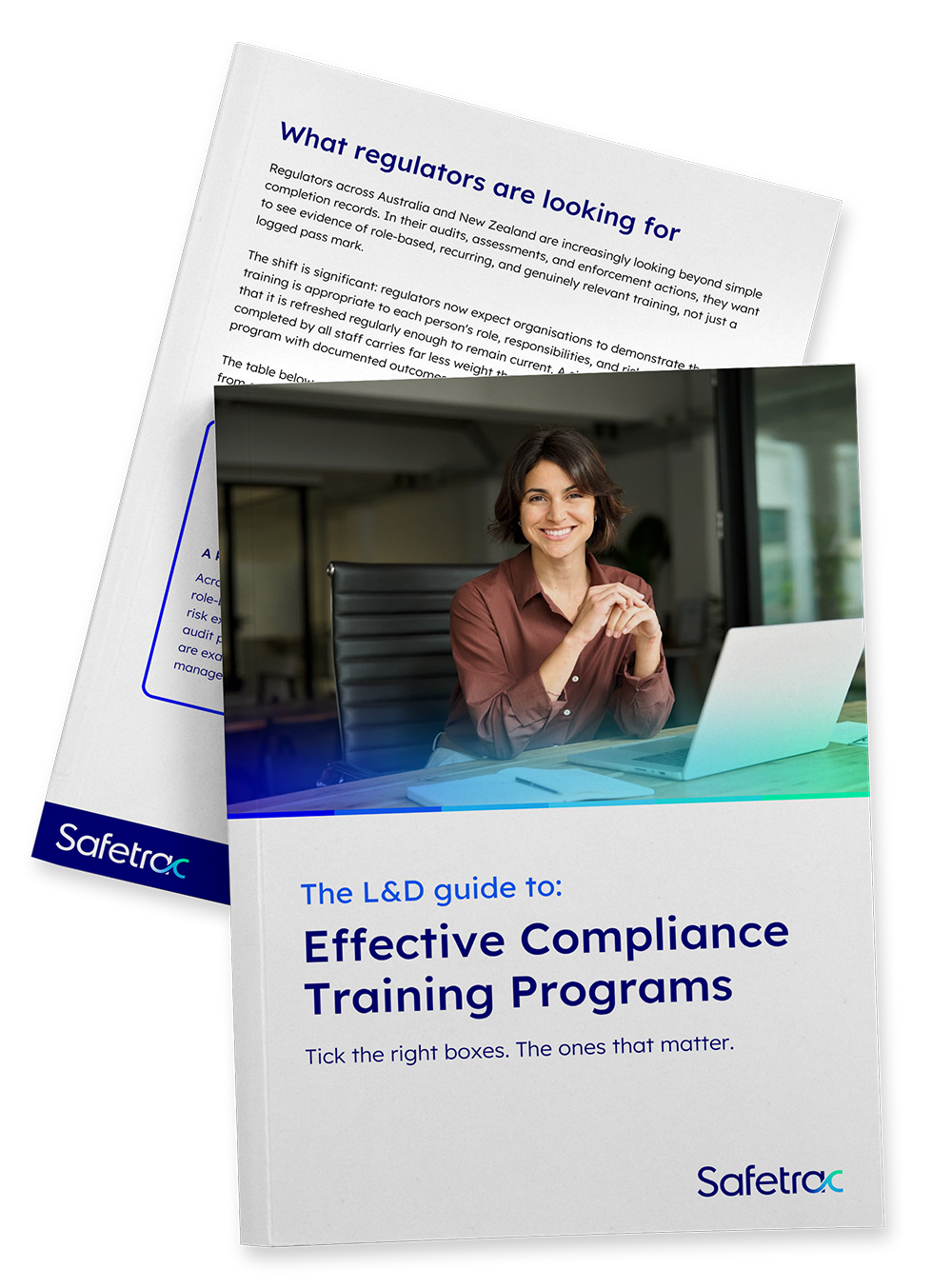
Get your 2026 guide to effective compliance training programs
Download your copy to find out the key areas to look for when designing an effective compliance training program.
Get the latest news
Stay updated with the latest news and expert insights on compliance, legislation, and industry trends.
Share
Latest news & insights
- 9 min